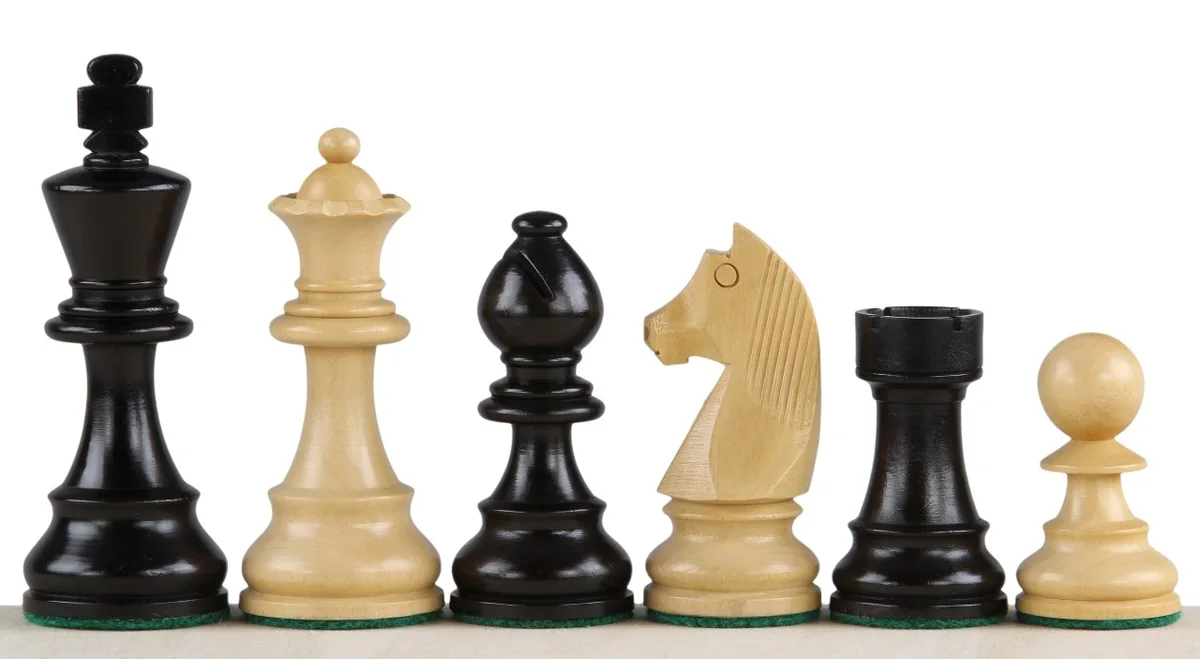
Each piece moves in its own way: the rook straight, the bishop diagonally, the queen both, the knight in an L-shape, the king one square and the pawn forward. You win by checkmating your opponent's king: it's in check and has nowhere left to go.
32
Pieces on the board at the start, 16 per player.
6
Types of pieces, each with its own way of moving.
Setting up the board
Place the board so that each player has a light square in the bottom right corner. The pawns go on the second rank. On the first rank, from the outside in: rook, knight, bishop. The queen goes on her own colour (the white queen on light), the king beside her. White starts.
How do the chess pieces move?
The piece can move hereThe piece can capture this
The king
The king moves one square in any direction. It may never move to a square where it can be captured.
The queen
The queen is the strongest piece. She moves as far as she likes, straight and diagonally, as long as nothing is in the way.
The rook
The rook moves as far as it likes, straight forward, backward or sideways.
The bishop
The bishop moves as far as it likes diagonally. So it always stays on the same colour.
The knight
The knight jumps in an L-shape: two squares straight and then one to the side. It's the only piece allowed to jump over other pieces.
The pawn
The pawn moves one square straight forward; from the starting position it may also move two squares. It captures diagonally forward. A pawn never moves backward.
Castling
Castling puts your king in safety and brings your rook into play in a single move. The king slides two squares towards the rook, and the rook jumps over it. It's only allowed if the king and rook haven't moved yet, nothing stands between them, and the king is not in check, doesn't pass through check and doesn't end up in check.
En passant
En passant (French for "in passing") is a special pawn capture. If a pawn moves two squares forward and lands next to an opponent's pawn, that pawn may capture it straight away as if it had moved only one square. It must be done on the very next move, or the right is lost.
Promotion: a pawn on the other side
When a pawn reaches the other side, it immediately becomes another piece of your choice: queen, rook, bishop or knight. You almost always choose a queen. So you can have more than one queen, which is why many chess sets include two extra queens.
Check, checkmate and stalemate
If your king is attacked, you are in check. You have to deal with it immediately: move the king, capture the attacking piece or put something in between. If you can't, it's checkmate and the game is lost. The fastest checkmate is Fool's Mate, in two moves.
If the player to move cannot make a single move but is not in check, it's stalemate. Stalemate is a draw: nobody wins.
Draw
A game ends in a draw on stalemate, when both players agree, when the same position occurs three times, when fifty moves have been played without a capture or pawn move, or when there aren't enough pieces left to give mate, such as king against king.
Play your first game
Do you know the rules? Then play straight away against an easy computer. After every move, a coach explains what went well.